This is a follow on post from : Feb 2011 which looked at 2006 - 2010 Fortune 500 data. This post updates to 2013 Fortune 500 updates.
Three fast risers: Apple, Google and Amazon continue their surge.
Innovation can manifest as rising sales; bring new products to new customers (new iPad users) or old customers (selling iPad to iPhone users) or reselling products or services to old customers (such as selling apps to iPhone users). The Fortune 500 traces rising sales (rather than profits) which are more difficult than profits to manipulate.
Two techniques to inflate sales and therefore confound the Fortune 500 as a measure of innovation are: 1. buying a competing business and hence buying sales, such as Amazon buying Book depository. Thus mergers artificially inflate a businesses Fortune 500 ranking at the cost of liquid assets (paying cash) or by issuing shares. Thus I would adjust Sales from year to year by subtracting out sales from purchased businesses 2. Buying into a new industry by acquiring a business, such as Microsoft buying Nokia, Google buying Motorola, Facebook buying Instagram, or Yahoo buying Flickr. Such business purchases do not reflect bringing new products to old customers or reaching out to new customers.
These three fast risers can be compared to slower risers: Microsoft and Nike.
For comparison, three other companies are fairly static: Coca Cola, AT&T, and Berkshire Hathaway.
For companies near the top of the Fortune 500 there is nowhere further to go.
The Data: (2006 - 2013) [Click on image to see all the data]
Data at: figshare. http://dx.doi.org/10.6084/m9.figshare.870121
The Picture: (LHS is Fortune 500 ranking)
Wednesday, November 20, 2013
Thursday, August 1, 2013
First postdoc papers on Value; which to tackle first...
I have arranged for four weeks leave from my work at ANDS (Australian National Data Service), so tomorrow I can start writing my first postdoc papers on Value and Innovation. But which paper to work on first. Here are the options:
The first paper, to make it more manageable could be split into two papers:
Which paper would be the most fun and keep me most motivated? Probably the tools paper.
Which paper is the obvious choice to start with? The theory paper, but it is a drag... and likely long and slow... and I am impatient for progress...
Which paper makes most sense to start with?
So ultimately this becomes a value question. The tools paper is 'fun' and 'quick', 'interesting' and 'lower impact', but the theory paper is 'slow' and 'laborious' but with 'high impact'. The tools paper also would make less sense without the theory paper to explain what is going on. However, I could likely reference the PhD document heavily for the conceptual basis.
Hmmm... your comments appreciated...
...after sleeping on it... I have realised the Dimensions of Value is the right place to start. See Ferrers (2009) for an early mention.
- A value theory of innovation (value in theory)
Target Journal: Australian Journal of Emerging Technology, Research Policy, Journal of Product Innovation Management, IM Policy and Practice and ultimately Harvard Business Review
- Value management: managing innovation, creating value (value in practice)
Target Journal: Sloan Management Review 1000, 5000 words
- Measuring innovation: a value approach (value in practice)
Target Journal: Research Policy
- Value Frontier: visualising value (a value tool)
Target Journal: Sloan Management Review 1000 words
- A fifth paper, I thought about today is: Accounting for Research and Innovation and why accounting concepts are poorly suited for business and government measuring innovation, and why value is a better framework to assess innovation by.
Target Journal:
- A sixth paper is about a value interpretation of using case studies to measure research impact. See Dept of Innovation Discussion Paper on Measuring Research Impact: http://www.innovation.gov.au/impact for which comments are due shortly on August 16.
Target Journal: Research Policy
The first paper, to make it more manageable could be split into two papers:
- Dimensions of value: what consumers value in 3G mobile phones
- The process of value: how consumers construct value in 3G mobile phones
Which paper would be the most fun and keep me most motivated? Probably the tools paper.
Which paper is the obvious choice to start with? The theory paper, but it is a drag... and likely long and slow... and I am impatient for progress...
Which paper makes most sense to start with?
So ultimately this becomes a value question. The tools paper is 'fun' and 'quick', 'interesting' and 'lower impact', but the theory paper is 'slow' and 'laborious' but with 'high impact'. The tools paper also would make less sense without the theory paper to explain what is going on. However, I could likely reference the PhD document heavily for the conceptual basis.
Hmmm... your comments appreciated...
...after sleeping on it... I have realised the Dimensions of Value is the right place to start. See Ferrers (2009) for an early mention.
Saturday, May 25, 2013
Understanding the changing needs of customers: Akolade
I am giving a presentation at a Financial Analytics for Business Management (for Akolade) conference in Melbourne next week, and provide the presentation (pdf 6Mb; May 2011; Understanding consumer value; other presentations) below:
Key points:
- let's measure value alongside other accounting measures
- Value is complex
- measuring value is complex
- some approaches to measuring value in practice: the Australian National Data Service (where I work: I was interested to know the process ANDS has in place to know what customers value)
- value theory: the 3G mobile phone study (my PhD):
The conference is interested in: Identify[ing] ways to measure and maximize the value of intangible assets...
The presentation in text (and your comments as always are welcome... questions, examples, critique is also welcome as this helps flush out and improve the Value Theory)....
Draft of presentation: (references below)
2.Measuring perceived customer value; sensing customer value
3.Exploring what value means for your customers: Case Study - 3G Mobile phones 2004 - 2009
Business Analytics:
- Statement of Accounting concepts; reliable, measureable; objective
What is value?
- Aristotle: utility, exchange, conspicuous consumption (Gordon 1964)
- Marx (1865): labour theory of value
- Bailey (1838): in the eye of the beholder; subjective
- Vargo and Lusch (2004): co-construction, value conversation
Who are ANDS.org.au: Australian National Data Service?
- customers: Public Sector and Universities, Department
- goal: more researchers reusing research data more often
- funding: $75 million from Dept. of Industry, Innovation, Climate Change, Science and Research
- resources: 50 staff, five states
Measuring Value at ANDS
- Customer contribution: co-investment
- subjective: customer satisfaction
- examples:
Process of tracing Value at ANDS
- Issues Register; documenting issues (245)
- Client Liaison Officers; face to face
- GoTo Meeting; webinars,
- Monthly Informals
- eResearch Australasia annual conference
Issues Register: Value Management in action
- from Progress and Final Reports
- Section to comment on:
- issues needing ANDS facilitation
- issues need direct advice and support
- achievements to share
- Director's review; traffic lights, keywords, weekly review, follow up action
- next steps: status by customer, Business Intelligence, current issues
Understanding Consumers: 3G mobile phones: Value is complex
- what do they value?
- 12 value meanings;![]()
- 80 value elements; Appendix of thesis (Ferrers 2013)
- a simple example
- Consumer quotes
Consumer quotes:
Understanding your customers;
- B2B or B2C
- Value Management
- Value Leadership
- Value Conversation
Key References:
Aust Accounting Research Foundation (1995). SAC4: Definition and Recognition of the Elements of Financial Statements. Viewed online at: http://www.aasb.gov.au/admin/file/content102/c3/SAC4_3-95.pdf
Bailey, S. (1825). A Critical Dissertation on the Nature, Measures and Causes of Value. London School of Economics (1931), viewed 30.06.2009 at http://books.google.com/books?id=onJnPnLxPcMC&printsec=frontcover&dq=bailey+1825+value &source=gbs_book_other_versions_r&cad=8#v=onepage&q=&f=false
Ferrers, R. (2011). Value as a resolution of forces. Viewed online at: http://valman.blogspot.com.au/2011/05/value-as-resolution-of-forces.html
Ferrers, R. (2011). Beyond Innovation Management: Towards Value Management. Viewed online at: http://valman.blogspot.com.au/2007/01/beyond-innovation-management-towards.html
Ferrers, R. (2013). A consumer 'value' theory of innovation: a grounded theory approach . figshare. PhD thesis. http://dx.doi.org/10.6084/m9.figshare.680002 Retrieved hh:mm, mmm dd, 20xx (GMT)
Gordon, B. (1964) Aristotle and the Development of Value Theory. The Quarterly Journal of Economics, 78, 1, 115-128; viewed online at http://qje.oxfordjournals.org/content/78/1/115.full.pdf.
Kim, W. & Mauborgne, R. (2005). Blue Ocean Strategy: How to Create Uncontested Market Space and Make Competition Irrelevant. Harvard Business School Press. More at: http://en.wikipedia.org/wiki/Blue_Ocean_Strategy
Marx, K. (1865/1919). Value, Price and Profit. Melbourne: The Workers Intelligence Bureau.
Sveiby, E (1997). The New Organisational Wealth: Measuring and Managing Intangible Assets. Berrett-Keohler See summary at: http://ptarpp2.uitm.edu.my/silibus/neworgan.pdf
Vargo, S. L., & Lusch, R. F. (2004). Evolving to a new dominant logic for marketing. Journal of marketing, 1-17. Available online at: http://courses.ischool.berkeley.edu/i210/f07/readings/VargoLusch.pdf
Key points:
- let's measure value alongside other accounting measures
- Value is complex
- measuring value is complex
- some approaches to measuring value in practice: the Australian National Data Service (where I work: I was interested to know the process ANDS has in place to know what customers value)- value theory: the 3G mobile phone study (my PhD):
The conference is interested in: Identify[ing] ways to measure and maximize the value of intangible assets...
The presentation in text (and your comments as always are welcome... questions, examples, critique is also welcome as this helps flush out and improve the Value Theory)....
Draft of presentation: (references below)
Understanding the change in customer needs
1.Understanding what customers value in a service environment: Australian National Data Service2.Measuring perceived customer value; sensing customer value
3.Exploring what value means for your customers: Case Study - 3G Mobile phones 2004 - 2009
Business Analytics:
- Statement of Accounting concepts; reliable, measureable; objective
What is value?
- Aristotle: utility, exchange, conspicuous consumption (Gordon 1964)
- Marx (1865): labour theory of value
- Bailey (1838): in the eye of the beholder; subjective
- Vargo and Lusch (2004): co-construction, value conversation
Who are ANDS.org.au: Australian National Data Service?
- customers: Public Sector and Universities, Department
- goal: more researchers reusing research data more often
- funding: $75 million from Dept. of Industry, Innovation, Climate Change, Science and Research
- resources: 50 staff, five states
Measuring Value at ANDS
- Customer contribution: co-investment
- subjective: customer satisfaction
- examples:
Process of tracing Value at ANDS
- Issues Register; documenting issues (245)
- Client Liaison Officers; face to face
- GoTo Meeting; webinars,
- Monthly Informals
- eResearch Australasia annual conference
Issues Register: Value Management in action
- from Progress and Final Reports
- Section to comment on:
- issues needing ANDS facilitation
- issues need direct advice and support
- achievements to share
- Director's review; traffic lights, keywords, weekly review, follow up action
- next steps: status by customer, Business Intelligence, current issues
Understanding Consumers: 3G mobile phones: Value is complex
- what do they value?
- 12 value meanings;
- 80 value elements; Appendix of thesis (Ferrers 2013)
- a simple example
- Consumer quotes
Consumer quotes:
Understanding your customers;
- B2B or B2C
- Value Management
- Value Leadership
- Value Conversation
Key References:
Aust Accounting Research Foundation (1995). SAC4: Definition and Recognition of the Elements of Financial Statements. Viewed online at: http://www.aasb.gov.au/admin/file/content102/c3/SAC4_3-95.pdf
Bailey, S. (1825). A Critical Dissertation on the Nature, Measures and Causes of Value. London School of Economics (1931), viewed 30.06.2009 at http://books.google.com/books?id=onJnPnLxPcMC&printsec=frontcover&dq=bailey+1825+value &source=gbs_book_other_versions_r&cad=8#v=onepage&q=&f=false
Ferrers, R. (2011). Value as a resolution of forces. Viewed online at: http://valman.blogspot.com.au/2011/05/value-as-resolution-of-forces.html
Ferrers, R. (2011). Beyond Innovation Management: Towards Value Management. Viewed online at: http://valman.blogspot.com.au/2007/01/beyond-innovation-management-towards.html
Ferrers, R. (2013). A consumer 'value' theory of innovation: a grounded theory approach . figshare. PhD thesis. http://dx.doi.org/10.6084/m9.figshare.680002 Retrieved hh:mm, mmm dd, 20xx (GMT)
Gordon, B. (1964) Aristotle and the Development of Value Theory. The Quarterly Journal of Economics, 78, 1, 115-128; viewed online at http://qje.oxfordjournals.org/content/78/1/115.full.pdf.
Kim, W. & Mauborgne, R. (2005). Blue Ocean Strategy: How to Create Uncontested Market Space and Make Competition Irrelevant. Harvard Business School Press. More at: http://en.wikipedia.org/wiki/Blue_Ocean_Strategy
Marx, K. (1865/1919). Value, Price and Profit. Melbourne: The Workers Intelligence Bureau.
Sveiby, E (1997). The New Organisational Wealth: Measuring and Managing Intangible Assets. Berrett-Keohler See summary at: http://ptarpp2.uitm.edu.my/silibus/neworgan.pdf
Vargo, S. L., & Lusch, R. F. (2004). Evolving to a new dominant logic for marketing. Journal of marketing, 1-17. Available online at: http://courses.ischool.berkeley.edu/i210/f07/readings/VargoLusch.pdf
Wednesday, May 1, 2013
Measuring Innovation: National Value Management
The Science and Technology in Technology in China course has an interesting assignment on measuring an economy's innovation capacity:
Aside from the innovations systems approach (wikipedia), can you think of other methods for analyzing an economy’s innovation capacity and output (from a macro perspective)? If the answer is yes, explain the advantages/disadvantages of the alternative in comparison with the innovation systems approach.
My answer builds on Solow's Growth Model, I learnt about in the Model Thinking Coursera course:
1. A Value Growth Model to analyse an economy's innovation capacity
My model, the Value Growth Model (VGM), is an extension of Solow's Growth Model with an added Value component. Solow, a Nobel Prize winner (pictured below) in Economics (1990), proposed a formula simplified to:
O = f(L, K, T)
Namely that an economy's output (O) or GDP, is a function of the inputs, labour (L), capital (K) and technology (T) or innovation. So technology allows more output from a given amount of workers and investment. T is really the intangibles left over after the tangible inputs are counted, including innovation, skills, intellectual capital and networks. I will consider T to substitute for innovation.
To O, I add V for value. Value is the intangible benefits consumers get from purchases above what they pay for goods. V can be measured relatively by asking the question of a product, firm, industry or country (X); does X provide more value than last year? A sample of say 1000 people are asked the question on a scale of 1-5, where 1 is much worse and 5 is much better.
Thus, O + V = f(L ,K ,T).
The macro innovation output (T) is thus solved as the residual in the formula after finding values for O, V, L, and K. The innovation capacity is the maximum value of T over time.
2.Advantages and disadvantages of the VGM model
The advantage of VGM is that T can be found for a sector, firm, industry or nation. The VGM applies equally to services, like health, finance, media and government as well as more traditional manufacturing. The VGM also takes advantage of both tangible and intangible inputs and outputs, and is relatively straightforward to calculate.The VGM model is quite simple to understand. While T is not broken down, it provides a concrete measure of innovation.
The disadvantage of VGM is that the focus is really on output rather than capacity. Capacity is inferred from the maximum T over time, but this assumes that T does not vary randomly, which is not known. The model focuses on financial measures, but excludes the value of connections in the economy; these are included in T. The VGM is less a prescriptive policy guide than a measure like inflation, GDP or unemployment. The VGM is not an absolute measure, since value is measured relatively rather than absolutely.
3. Comparing the VGM with the innovation systems (IS) approach
The VGM is more simple, straightforward and concrete than IS. VGM is a measure whereas IS is a descriptive method of analysis. IS is complex, powerful, dynamic and interactive but it is also a little vague about where to begin since it includes a very wide range of possible information. IS is also more capacity oriented so makes more sense in manufacturing, mining and telecoms sectors where capacity is important, whereas VGM can be used to assess innovation in services, government and non-profits through understanding value created. IS focusses more on inputs to innovation and firms whereas VGM focusses more on outputs of innovation and benefits consumers get from innovation (value). The VGM is more simple, direct and thus quicker and more straightforward to calculate.
Aside from the innovations systems approach (wikipedia), can you think of other methods for analyzing an economy’s innovation capacity and output (from a macro perspective)? If the answer is yes, explain the advantages/disadvantages of the alternative in comparison with the innovation systems approach.
My answer builds on Solow's Growth Model, I learnt about in the Model Thinking Coursera course:
1. A Value Growth Model to analyse an economy's innovation capacity
My model, the Value Growth Model (VGM), is an extension of Solow's Growth Model with an added Value component. Solow, a Nobel Prize winner (pictured below) in Economics (1990), proposed a formula simplified to:
O = f(L, K, T)
![]() |
| Robert Solow, Nobel Prize winner 1990, Economics |
Namely that an economy's output (O) or GDP, is a function of the inputs, labour (L), capital (K) and technology (T) or innovation. So technology allows more output from a given amount of workers and investment. T is really the intangibles left over after the tangible inputs are counted, including innovation, skills, intellectual capital and networks. I will consider T to substitute for innovation.
To O, I add V for value. Value is the intangible benefits consumers get from purchases above what they pay for goods. V can be measured relatively by asking the question of a product, firm, industry or country (X); does X provide more value than last year? A sample of say 1000 people are asked the question on a scale of 1-5, where 1 is much worse and 5 is much better.
Thus, O + V = f(L ,K ,T).
The macro innovation output (T) is thus solved as the residual in the formula after finding values for O, V, L, and K. The innovation capacity is the maximum value of T over time.
2.Advantages and disadvantages of the VGM model
The advantage of VGM is that T can be found for a sector, firm, industry or nation. The VGM applies equally to services, like health, finance, media and government as well as more traditional manufacturing. The VGM also takes advantage of both tangible and intangible inputs and outputs, and is relatively straightforward to calculate.The VGM model is quite simple to understand. While T is not broken down, it provides a concrete measure of innovation.
The disadvantage of VGM is that the focus is really on output rather than capacity. Capacity is inferred from the maximum T over time, but this assumes that T does not vary randomly, which is not known. The model focuses on financial measures, but excludes the value of connections in the economy; these are included in T. The VGM is less a prescriptive policy guide than a measure like inflation, GDP or unemployment. The VGM is not an absolute measure, since value is measured relatively rather than absolutely.
3. Comparing the VGM with the innovation systems (IS) approach
The VGM is more simple, straightforward and concrete than IS. VGM is a measure whereas IS is a descriptive method of analysis. IS is complex, powerful, dynamic and interactive but it is also a little vague about where to begin since it includes a very wide range of possible information. IS is also more capacity oriented so makes more sense in manufacturing, mining and telecoms sectors where capacity is important, whereas VGM can be used to assess innovation in services, government and non-profits through understanding value created. IS focusses more on inputs to innovation and firms whereas VGM focusses more on outputs of innovation and benefits consumers get from innovation (value). The VGM is more simple, direct and thus quicker and more straightforward to calculate.
Monday, April 22, 2013
Beyond a linear model of innovation
I am currently studying two courses on Coursera. One is about the micro - individual consumer decision making; Irrational Behaviour. The second looks at the macro - Innovation policy in China; Science, Technology and Society in China This weeks assignment asked students to postulate a better version of the linear model of innovation:
The Course version of the linear model: basic research -> applied research -> development > testing -> commercialisation
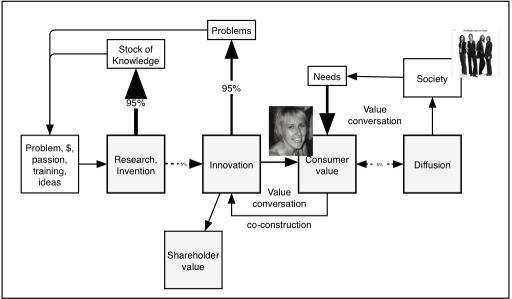
I prefer a simpler version of the linear model: research/invention -> innovation -> diffusion. Long ago, I posted an extension to the linear model include value, titled 'Where does value fit in innovation?'.
On reflection, I have updated my thinking to
propose a modified linear model, I recently tweeted:

My 500 word essay - Draft 1:
My alternative to the linear model
My model (pic.twitter.com/QuEySdFzkY) adds three new features to the linear model; which I summarise as research (new knowledge, basic and applied) -> innovation (new products, development and testing) -> diffusion (spread of products or commercialisation).
- Firstly and most importantly, it adds indications of the level of divergence from the linear path, suggesting most research doesn't create products, and most new products don't succeed in the marketplace. Success is uncommon.
- The second new feature is the model shows what happens as an alternate to succes, and adds two new activities; adding to the 'body of knowledge', for research that doesn't create products, and 'problems' for innovations which are not successful.
- Thirdly and lastly, between the last two phases; innovation and diffusion or as the lecture says between testing and commercialisation, I add a new assessment activity I call consumer value. Consumers judge the value of an innovation both before in choosing and after using a new product. The chance for a new product to spread depends on a favourable recommendation from early users.
- Minor changes also include loops back to research, and society affecting a consumer's needs.
Conceptual Differences - how my model is different in theory
The linear model is a one way model, with no alternate paths, and no feedback loops. My model adds both feedback loops and new stocks of problems and knowledge which result from getting off the linear path, which can restart the research process. Research is both science creating new knowledge and practical problem solving in industry.
Operational Differences - how my model is different in practice
My model shows innovations can arise from consumer pull, from solving innovation problems, as well as from science push. This is consistent with von Hippels' finding in his book "Sources of Innovation" (1988) that much innovation comes from solving business problems, rather than from science.
I commend this rework of the linear model of innovation for your consideration.
Monday, April 15, 2013
Set my thesis free... CC-BY... download the pdf...
My thesis arrived on the library catalogue, password protected, so I made my thesis freely available to download on figShare: http://dx.doi.org/10.6084/m9.figshare.680002
My thesis pdf: "A consumer value theory of innovation in 3G mobile phones" arrived Friday on the University of Queensland library catalogue ://lib.cat eSpace: http://espace.library.uq.edu.au/view/UQ:290360
But I was disappointed to see that the pdf file was only available to UQ staff and students, though it was great to see 7 downloads before I even knew that the catalogue entry was online.... So I set it free (CC-BY)@figShare: Understanding what consumers value in 3G mobile phones... A consumer 'value' theory of innovation in 3G mobile phones: a grounded theory approach http://shar.es/JXAU6 via
@figshare ... pdf to go..
One of the benefits of Figshare is:
- the allocation of a DOI : http://dx.doi.org/10.6084/m9.figshare.680002
A DOI is a permanent identifier and a custodian who promises to always make it available for the foreseeable future...
- a second benefit is that I put into action, with my own research, my work at ANDS to promote better research data management, sharing and reusing of data. In other words, I practice what I preach.
- a third benefit is I put a licence on my thesis: it is now released as CC-BY, which means I have shared the copyright with the world, so long as I am cited as the author, and the work is not commercialised.
My thesis pdf: "A consumer value theory of innovation in 3G mobile phones" arrived Friday on the University of Queensland library catalogue ://lib.cat eSpace: http://espace.library.uq.edu.au/view/UQ:290360
But I was disappointed to see that the pdf file was only available to UQ staff and students, though it was great to see 7 downloads before I even knew that the catalogue entry was online.... So I set it free (CC-BY)
One of the benefits of Figshare is:
- the allocation of a DOI : http://dx.doi.org/10.6084/m9.figshare.680002
A DOI is a permanent identifier and a custodian who promises to always make it available for the foreseeable future...
- a second benefit is that I put into action, with my own research, my work at ANDS to promote better research data management, sharing and reusing of data. In other words, I practice what I preach.
- a third benefit is I put a licence on my thesis: it is now released as CC-BY, which means I have shared the copyright with the world, so long as I am cited as the author, and the work is not commercialised.
Friday, March 1, 2013
This blog in a picture: Wordle
This blog has been turned into a single picture, a Wordle word cloud, showing the most common terms used in this blog: innovation, value, consumers, business, NBN, thesis, data, management.
For your viewing pleasure. Thanks to wordle.net, an IBM project.
Previously chapters of the thesis were shown as a series of similar word clouds here (Jan 2011).
For your viewing pleasure. Thanks to wordle.net, an IBM project.
Previously chapters of the thesis were shown as a series of similar word clouds here (Jan 2011).
Subscribe to:
Posts (Atom)